



If you’re new to the apparel decoration game, seasoned pros will tell you:
Reducing unnecessary costs unlocks more profit for your business.
And if you’re new to the heat transfer game, we’ll tell you:
The key is choosing the right transfer.
So, let’s get real: not every apparel order you fulfill needs transfers that will last 250+ washes. If you purchase the most durable transfers for every job, you may be spending more money than you need to.
Example: You land a construction company as a client. It’s only natural to think you’d need the most durable transfer for their t-shirts. However, unless they’re like The Village People–doing musical numbers instead of construction–they’ll most likely destroy the garment itself before 250+ wash cycles will destroy the transfer, so you’d be perfectly fine making an economical decision by using a less durable transfer. Construction vests, on the other hand, get swapped out far less than t-shirts do, so you may want a transfer that’s more durable for those.
When choosing the correct transfer, it can be overwhelming. Different companies use different trademarked names for the same type of transfer. So, which ones are the same, and what’s the difference between the ones that aren’t?
Let’s cut the fluff and simplify things: there are only three core printing methods companies use when manufacturing heat transfers:
- Screen Printing
- CMYK (digital)
- Screen Printing + CMYK (digital)
When researching which transfer is right for your job, look past the trademarked name, and see which method of printing is used to make the transfer, this will tell you the true type of transfer that it is:
- Screen Printing = Screen Printed Transfer
- CMYK (digital) = Direct-to-film Transfer
- Screen Printing + CMYK = Hybrid Transfer
(Reference Image: Side-by-side comparison graphic showing EPT, FCF, and DTF sheets with labels “Screen Printed,” “Hybrid,” and “Direct-to-Film.”)
So which one is right for you? Let’s break it down.
Screen Printed Transfers
We Call ‘Em, ‘Error Proof Transfers®
Best For
Corporate & athletic wear, retail clothing brands
Best For
Corporate & athletic wear, retail clothing brands
Best For
Corporate & athletic wear, retail clothing brands
Best For
Corporate & athletic wear, retail clothing brands
Best For
⭐️⭐️⭐️⭐️⭐️
Best For
Corporate & athletic wear, retail clothing brands
Best For
Corporate & athletic wear, retail clothing brands
Best For
Corporate & athletic wear, retail clothing brands
How Screen Printed Transfers Are Built
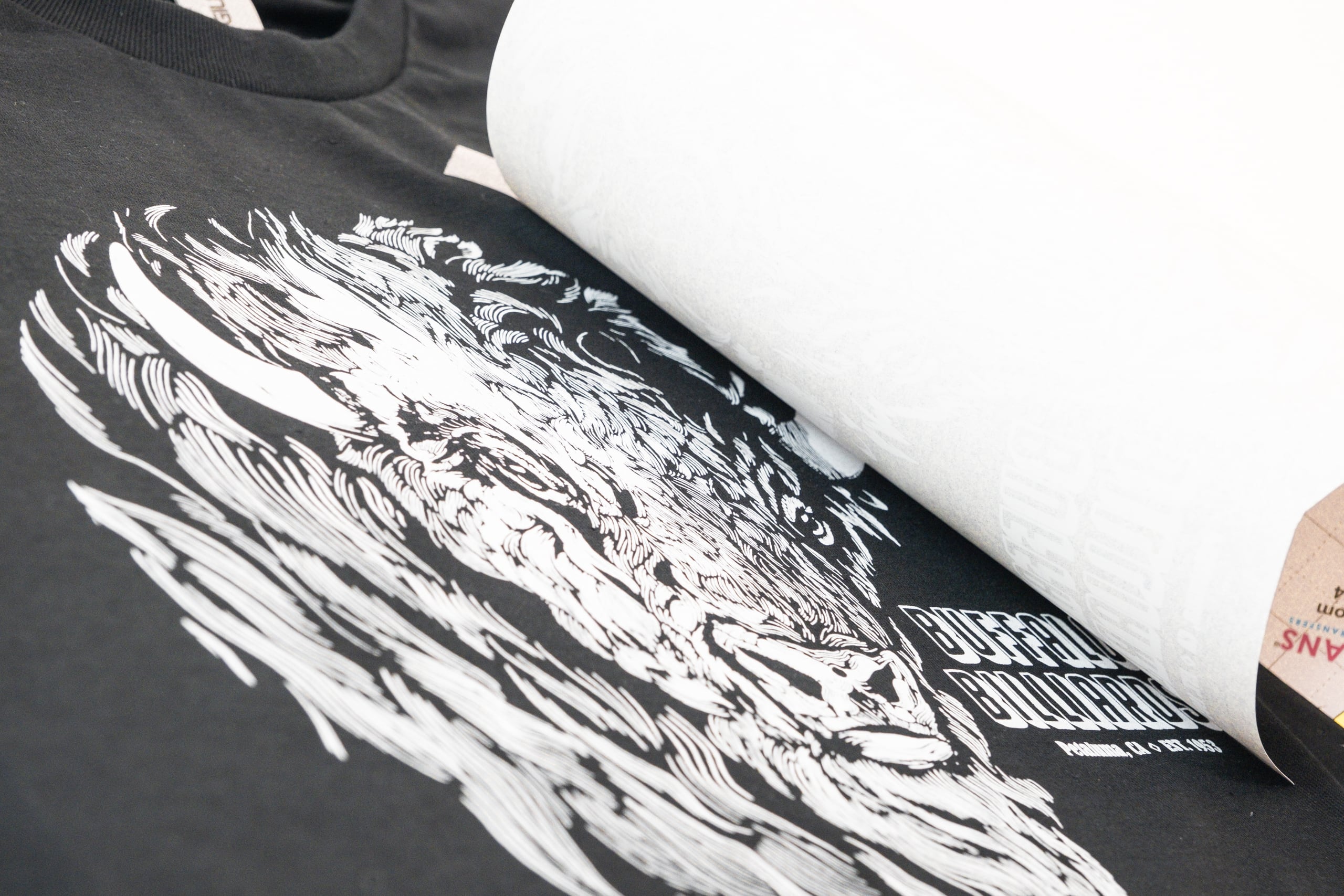
Screen printed transfers follow the same printing process as a traditional screen printed t-shirt, but rather than a t-shirt, they’re printed onto a sheet of wax-coated transfer paper.
First, ink is pushed through an individual mesh screen for each color of your artwork after the color that has been laid before it has cured (dried). Then, a layer of clear plastisol ink is applied over the whole design, providing a cohesive, wet layer for adhesive powder to be applied to. Lastly, the sheet is cured one final time and shipped.
When you receive your screen printed transfers, they will be mirrored so that they read backwards, or right to left. This is because they were printed on opaque paper in reverse, starting with the top layer and ending with the bottom layer.
You’ll flip the transfers over, placing them ink side down, and press them using a heat press. The heat applied melts the adhesive powder, bonding the ink permanently into the fabric. The result–your artwork printed on a garment, reading correctly from left to right with that classic screenprinted look and feel.
Quick Tip: Order a free sample pack from versatranz.com. You’ll find a swatch booklet inside containing all of our pre-mixed spot colors for screen printed transfers. Refer to this swatch booklet as you’re designing artwork, therefore you’ll know EXACTLY how your colors are going to look when printed.
Hybrid Transfers
We Call ‘Em, “Full Color Fusion®”
Best For
Corporate & athletic wear, retail clothing brands
Best For
Corporate & athletic wear, retail clothing brands
Best For
Corporate & athletic wear, retail clothing brands
Best For
Corporate & athletic wear, retail clothing brands
Best For
⭐️⭐️⭐️⭐️⭐️
Best For
Corporate & athletic wear, retail clothing brands
Best For
Corporate & athletic wear, retail clothing brands
Best For
Corporate & athletic wear, retail clothing brands
How Hybrid Transfers Are Built
Hybrid transfers combine two print methods. First, an HD photo printer uses CMYK toner ink to print photo-quality and gradient heavy artwork directly onto a sheet of clear PET film. After the artwork has been printed, a layer of white plastisol is screen-printed onto the back of it, giving it extra durability and opacity.
You might notice the white layer stops millimeters from the edge of the artwork. This is so that it doesn’t bleed when the transfer is pressed, causing a white outline around the artwork. After the white layer has cured, clear plastisol is applied right to the edge of the artwork, creating a protective seal for the CMYK print. Then, adhesive powder is applied to the clear layer while still wet. Lastly, the sheet is cured one more time and shipped.
When you receive your transfers, you will want to place them ink side down just like you would a screen printed transfer, but because it is on clear PET film, you will be able to see through it and read the artwork in correct orientation–from left to right–when placing the transfer ink side down on the garment.
The heat applied from the heat press melts the adhesive powder, bonding the ink permanently into the fabric.The pairing of CMYK and screen printing keeps the full-color vibrancy of the digital print from being altered by the dye of the garment, and gives it the staying power of plastisol ink.
Quick Tip: Artwork containing large blocks of ink without any knockouts (negative space in your art that allows the garment to come through), can lead to a hybrid print feeling heavy and not super malleable. Instead, you want your print to fold easily and crease with garment. So, add as many knockouts as you can, allowing the garment to come through as much as possible, resulting in a much softer and malleable print.
Direct-to-Film Transfers (DTF)
We Call ‘EM, VersaColor®
Best For
Corporate & athletic wear, retail clothing brands
Best For
Corporate & athletic wear, retail clothing brands
Best For
Corporate & athletic wear, retail clothing brands
Best For
Corporate & athletic wear, retail clothing brands
Best For
⭐️⭐️⭐️⭐️⭐️
Best For
Corporate & athletic wear, retail clothing brands
Best For
Corporate & athletic wear, retail clothing brands
Best For
Corporate & athletic wear, retail clothing brands
How DTF Transfers Are Built
DTF starts with digital printers that use water based, CMYK toner ink to print artwork directly onto a roll of clear PET film. As the printer is laying down the artwork, it is also printing the opaque backing that works as the dye blocker using white, water based toner ink as well. While the print is still wet, adhesive powder is applied to it. The roll is then cured, cut, and shipped.
When you receive your transfers, you will still want to place them ink side down like you would a screen printed transfer, or a hybrid transfer. Because it is on clear PET film you will be able to see through it and read the artwork from left to right when flipping the transfer ink side down and placing it on the garment.
Once pressed, the adhesive layer bonds the ink into the fibers of the fabric
Quick Tip: Because DTF is lower priced than screen printed and hybrid transfers, and are made by printers that prioritize speed, order a gang sheet containing swatches of your most frequently used colors. This way, you can refer to that when designing and know how all of your CMYK printed colors will look.
Choosing the Right Transfer
If You’re Just Starting Out
Example: You’re printing a couple of tees for you and your co-hosts to wear during the podcast you just started.
Pick DTF: It’s economically priced and there are no minimums. Plus, if you plan to wear the tees almost exclusively during the podcast, they will get washed far less than the t-shirts that are part of your everyday wardrobe–so the lower wash count on durability will be fine.
If You’re an Established Brand
Example: You’ve scaled your passion project into a full blown clothing brand that is selling. Congrats, that is a huge accomplishment. You care about the quality and you want your garments to last as long as your customers want to wear them.
Pick screen printed: These days, a screen printed transfer can go to retail, they’ve gotten that good. If you’re selling apparel with designs your customers don’t want to see crack, peel, or fade, screen printed transfers are the only way to go.
Other Real-World Scenarios
- Sports jerseys → Screen printed. Mom is going to wash that jersey after every game and she’s going to nuke it in the dryer to get it done as soon as possible.
- Band merch with photos → Hybrid. You need a digital printing process and you want the added durability for the fans.
- Trial run of 5 shirts → DTF. Low minimums and fast turnarounds.
- Pop-up market with many designs → DTF. Gang them all up on a roll and have them ready to go.
- Corporate client with strict brand colors → Screen Printed. You can’t beat the color accuracy
Bottom Line
- Screen Printed → durability + bold and accurate colors
- Hybrid → durability + full color detail
- DTF → speed + full color detail
Match the transfer to the job. Start with the flexibility and economical pricing of DTF. Then, level up to hybrid or screen print when your project demands durability or high quantities. But, as a seasoned pro, you might even have a demanding client who needs t-shirts in two days, and in that scenario DTF will swoop in to save you.